Google Summer of Code 2024 Results
Results from Dart contributors in Google Summer of Code 2024.
The Google Summer of Code (GSoC) program focuses on engaging new developers worldwide with open source software development. Google sponsors contributors to work with a mentoring open source organization on a 12-week programming project during the summer. Over the past 19 years, more than 20,000 contributors have participated in Google Summer of Code.
In 2024, Dart participated as a mentoring organization in Google Summer of Code for a fifth consecutive year. This year we received 50 project proposals from prospective participants around the world. Today, we spotlight some of the projects we mentored this summer. The contributors describe their projects in this post.
HTTP client using JNI bindings from OkHttp
#By Anikate De
Existing Dart HTTP clients couldn’t interact with native Android APIs, limiting support for KeyStore PrivateKeys, System Proxy, and User-Installed Certificates (all highly requested features by Dart users).
The open-source project, OkHttp, a popular choice for network-intensive applications on Android, possesses APIs that can seamlessly implement the above functionalities. Hence,
OkHttp was chosen as a starting point for this project. Using the GSoC 2022 project, package:jnigen, JNI Bindings for Dart were generated for several
OkHttp APIs. The OkHttpClient is fully conformant with the existing HTTP Clients. allowing for a hassle-free transition to using
OkHttpClient from any alternatives.
Besides asynchronous HTTP requests, package:ok_http
also supports WebSockets, which requires passing all tests in package:web_socket_conformance_test. This allows a smooth transition from any WebSocket alternative. Flutter applications using the
package:ok_http benchmark report the smallest APK size out of all the other HTTP clients Dart offers.
Leveraging the benefits of the OkHttpClient in your Flutter projects is as simple as importing it, and editing your current
Client object!
Read more about the details of the project in the GSoC contributor’s report.
Swift2ObjC: ObjC wrappers generator
#By Mohammad Eid
Dart can (indirectly) communicate with Swift code. This is done “through” ObjC, as Dart can communicate with C-based languages (like ObjC) using the
ffi package. Swift APIs can be annotated with
@objcto request that the compiler generate ObjC headers for them. Generating the ffi
bindings for Dart is done automatically with ffigen. For Swift, you’ll manually annotate the APIs that you want to communicate with..
Annotating Swift APIs might be more involved than adding an @objcannotation. What if you don’t own the module? If you can’t edit it, you must make a custom wrapper that mirrors the APIs so that you can annotate the methods. Also, since Swift is a modern language, and ObjC isn’t, you will likely encounter APIs that are not representable in ObjC out of the box, so you must work around these cases, too.
Swift2ObjC handles these things for you: It generates wrappers for Swift modules and annotates them with
@objc, while ensuring that all the APIs are representable in ObjC — the Swift module won’t compile, otherwise. I explain the implementation details in this
article
on Medium (which you can reference if you’re considering contributing to the tool as it’s still in active development). You can also dive into the source code in the
swift2obj
repo on GitHub.
Testing documentation comments with dartdoc_test
#
By Takuma Ichikawa
Dart allows code samples to be embedded within documentation comments. This is a beneficial practice, because it’s also published as API documentation and shows how to use the package in a way that is easy to understand for both package users and developers. However, code samples in documentation comments are not analyzed or tested, making it difficult to find errors and making them less maintainable. As projects and documentation grow, this issue becomes more significant.
Therefore for GSOC, I have developed the dartdoc_test
package to solve such problems. The dartdoc_test tool can extract and analyze code samples in documentation comments to find potential errors. By adding the package to your project and running it from the command line, you can find errors in all code samples. You can also perform static analysis of code samples when running the
dart test command, by adding the dartdoc_test test file.
It’s easy to try dartdoc_teston your Dart project by running the following two commands.
dart pub add dev:dartdoc_test
dart run dartdoc_test
To learn more, check out dartdoc_test
on pub.dev.
Generate dart:ffi bindings on the web using WASM with FFIgenPad
#By TheComputerM
Dart, as a language that can be compiled to various targets, includes capabilities that facilitate communication with native binaries. You can use packages like
dart:ffi to interact with C APIs and package:jni
to interact with Java code. You merely write some glue code to specify the type signature of the native function you are calling.
The problem arises when you use a library that has many exports, too many to write by hand. This problem is solved with
ffigen (a previous GSoC project), a tool that generates the bindings using just the library’s header files. To do that you would have to install
ffigen, set up all the proper dependencies and requirements, then (likely) iterate again and again. This isn’t exactly the definition of seamless and easy. So FFIgenPad came into being.
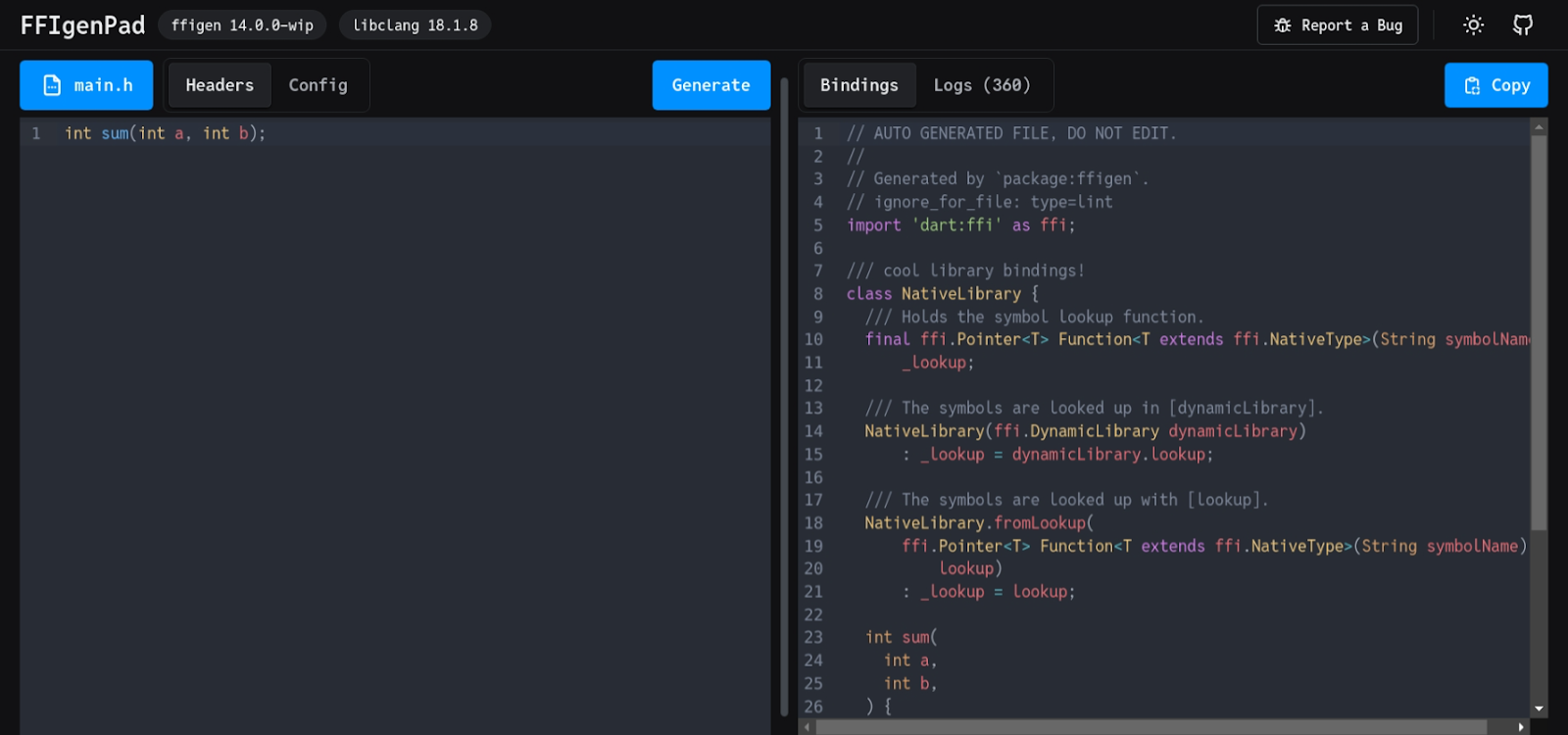
Another goal of the project was to test out the dart2wasm compiler (you can find my experiments in
this blogpost). Sure, we could have run
ffigen on a server and stuck a UI on it. Instead, I made sure that FFIgenPad runs fully on the browser by compiling both
libclang and ffigen to WebAssembly (why use a server for computation when you can use the client’s system).
Check out the demo at https://ffigenpad.surge.sh/
and the source code in my fork
on GitHub. I would like to thank my mentors Prerak Mann,
Daco Harkes, and Jackson Gardner
for chiming in whenever I asked for help.
More from Dart

Google Summer of Code 2026 results
Today, we spotlight the projects and results from contributors mentored by Dart and Flutter in Google Summer of Code 2026.

Dart in Google Summer of Code 2026
We’re excited to announce that the Dart project will mentor contributors for the seventh time in Google Summer of Code 2026!